


TL;DR
The most valuable skill I saw at a security conference this week had nothing to do with security: it was the ability to say what a technical control does in a sentence a CFO can repeat.
Highlighting 052 of the podcast: Andy and Eric Siron dig into why homelab and server hardware went vertical in 2026, who is eating the supply, and why the prices probably do not come all the way back.
The Take: hardware just got expensive in the worst budget climate in years, and “DDR5 is up 125%” is not a sentence that funds a refresh; the business-outcome version is.
Community Signal: Packet Protector’s episode on translating security work into business outcomes, with concrete moves like reading your company’s own earnings call before you ask for money.
Tool of the Week is Netdata, because the fastest way to win a hardware argument is to walk in with the utilization data instead of a vibe.
From the Console
I spent this week at a security conference in the Dallas area, and the most useful thing I heard all week had nothing to do with security.
It was at XChange Security, a room full of MSPs and MSSPs who run other people’s infrastructure for a living. These are not people who need convincing that email authentication matters. And yet the conversation that kept surfacing, over and over again, was not about attack surface or detection coverage. It was about how to keep a security practice funded when the person signing the checks does not understand a single thing you do.
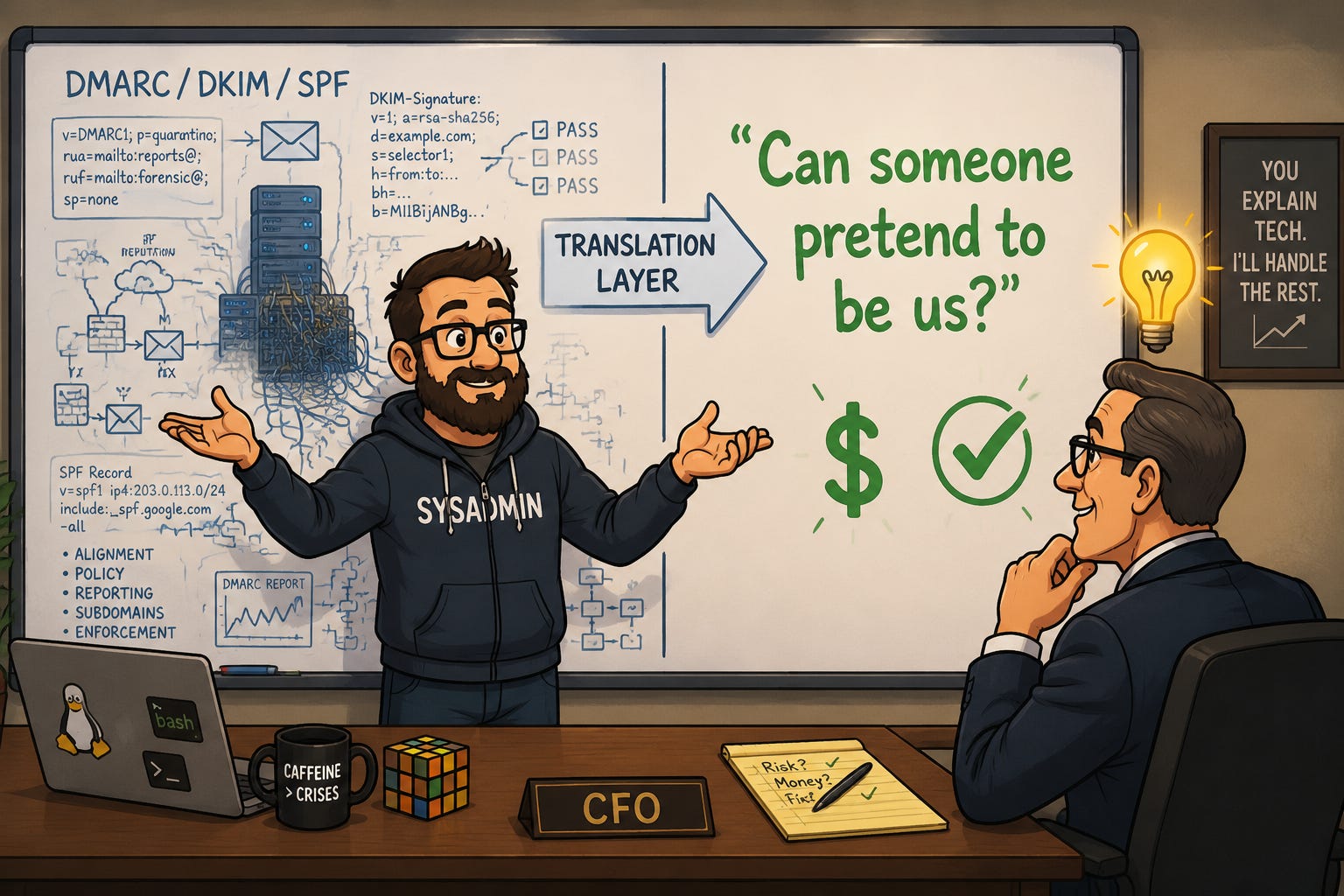
One thing I’ve learned after being in tech as long as I have…. No executive has EVER cared how your DMARC, DKIM, and SPF records are configured. That is a genuinely interesting conversation to have with me, at nerd hour, over a beer. Like…seriously. I’ll geek out over DMARC with all the other techs. That said, it’s a terrible conversation to have with your CFO. What the CFO wants to know is whether someone can impersonate the company to its customers, its vendors, and its bank. That is the whole question. Same three records, completely different sentence.
We are in a stretch where a lot of IT departments are under a microscope on both budget and headcount. In that climate, the ability to do the technical work is table stakes; it is assumed, and it does not save your seat. The thing that saves your seat is being the person who can stand in front of leadership and translate the work into an outcome they can act on. Not “we deployed the thing.” Instead: “we closed the gap that lets someone pretend to be us.”
Call it the translation layer. It sits between what you actually did and what the business heard, and most technical people never build it. The ones who do are the ones who are still employed when the spreadsheet gets tight.
The latest on the SysAdmin Weekly Podcast
Episode: Why Is Homelab Hardware So Expensive in 2026 (and When Will It Get Cheaper)?
Topic: Andy and co-host Eric Siron get into why memory, NAND, and storage prices went vertical in 2026, who is actually absorbing the supply, and what practitioners should do about a hardware market that stopped making sense.
Why it’s worth your time:
It puts real numbers on the pain: a Raspberry Pi board that was $120 is now $305, write-hardened NVMe drives are priced into orbit or flat out of stock, and Andy admits to pricing used flash storage on eBay before he pumped the brakes and re-architected his whole lab.
It explains the mechanics you will be quoting to your own boss soon: the AI buildout is eating memory and NAND capacity, three companies control roughly 95% of DRAM, a new fab takes three to five years, and Gartner has prices settling permanently above pre-shortage levels.
It lands on the skill this crunch is quietly reviving: right-sizing hardware to the workload instead of reflexively throwing spec at the problem, which is the discipline the cheap-hardware era let atrophy.
Watch on YouTube
Listen on Spotify
The Take
Your next hardware refresh got a lot more expensive, and you are going to have to go ask someone for the money. In this budget climate….. Good luck.
The episode above explains why the prices are what they are, and the short version is bleak: this is structural, not a blip, and it may not fully reverse for years. That is the part you already feel every time you open a vendor quote. Now…what happens next is that you have to walk into a room and justify a bigger number than last year to someone who was already looking for reasons to cut. And the way most of us instinctively make that case is exactly the way that fails.
Here is the failure mode. You lead with the mechanics, because the mechanics are true and you find them compelling. “DDR5 is up 125%, NAND is worse, the drives I need are on three-month lead times, and the refresh I scoped at forty grand is now closer to sixty.” Every word of that is correct. None of it funds anything. The person across the table heard “prices went up and IT wants more money,” which is the least persuasive sentence in the building.
Now translate it. “The storage under our billing system is past warranty and out of spare capacity. If it fails, we cannot invoice customers until it is replaced, and replacement parts are now measured in months, not next-day. I want to refresh it while we can still choose the timing instead of having the timing chosen for us.” Same request. Same dollars. But now it is a business-continuity decision with a clock on it, not a line item that went up. That is a sentence a CFO can carry into their own meeting and repeat.
That is the whole game right now, and it is the same muscle from up top in a different room. The hardware crunch did not just make gear expensive. It made the budget conversation harder at the exact moment the budget conversation got more hostile. The admins who get their refreshes approved this year will not be the ones with the best spec sheets. They will be the ones who showed up with the utilization data and the business consequence, and left the part numbers in their back pocket unless someone asked.
Community Signal
Packet Protector - “Translating Security Objectives into Business Outcomes” - Hosts JJ Minella and Drew Conry-Murray sit down with Eyvonne Sharp, who spent twenty-plus years going from technical IC to leadership, and the whole thing is a practical manual for the translation layer I keep going on about. The moves are concrete and a little uncomfortable in a good way: read your own company’s earnings call or 10-K to find out what leadership actually cares about before you ask for a dime, quantify your work in revenue or mission terms instead of hours saved, and drop the fear-based “reputational damage” pitch because seasoned executives have heard it a hundred times and tuned it out. If The Take this week resonated, this is the long-form version from people who have sat on both sides of the table.
Tool of the Week
Netdata - a free, open source (GPLv3+) monitoring agent that gives you per-second CPU, memory, disk, and network metrics on every node, with real-time dashboards and zero configuration to get started.
I am putting it here for a specific reason tied to The Take: the fastest way to win a hardware argument is to stop arguing and show the graph. Netdata is how you find out that the database server everyone swears is “maxed out” is sitting at 11% memory utilization, or that the box you were about to leave alone is genuinely out of headroom. That is the difference between right-sizing on data and right-sizing on a hunch, and it is the receipt you bring to the budget conversation. Honest scope: the agent is free and open source and runs comfortably on a homelab node at around 5% of a core and 150MB of RAM, and it scales up to real infrastructure. The catch is retention and the single-pane view across many machines. Long local history and a unified dashboard across a fleet lean on Netdata Cloud, which has a usable free tier for individuals and paid tiers once you are a team, or on self-hosting parent nodes if you want to keep everything in-house. For a homelab or a small shop that just needs to see what is actually happening right now, the free agent alone earns its keep.
Quick Win of the Week
Take the last status update or upgrade request you sent up the chain, the real one, and rewrite the opening sentence so a non-technical executive could repeat it out loud without you in the room. Cut every acronym and every part number from that first line. If you cannot state the business outcome or the business risk in one sentence, that is not a writing problem, it is a sign you have not figured out why the work matters to anyone holding a budget, and better to learn that at your desk than in the meeting. Fifteen minutes, one sentence, and you will use the skill again within the month.
Fun Retro SysAdmin Fact
Hardware sticker shock is not new: in 1956, IBM’s 305 RAMAC, the first computer to ship with a moving-head hard disk, stored a whopping 5 million characters (about 5MB) across fifty 24-inch platters and leased for roughly $3,200 a month, which is north of $36,000 in today’s money, so the next time a NAND quote makes you wince, remember your homelab holds a few million times that for the price of a nice dinner.
Until Next Week
The technical work is the part you already know how to do; the sentence you say to the person holding the budget is the part that keeps you employed.
Stay Frosty,
Andy
SysAdmin Weekly